



A China factory visit shows you what emails and quotes cannot. You see the machines. You see how the manufacturer tests its goods. You meet the people who will run your order.
Done well, a visit replaces guesswork with facts. Done badly, it costs a week and teaches you little.
CAMAL has visited over 400 manufacturers in China. This guide shares the checks that matter most.
Quick answers
- Who should go: buyers placing a large first order, or buying a safety-critical part.
- How many visits a day: two at most.
- How far ahead to book: 2 to 3 weeks.
- Budget for one region: USD 2,000 to 3,000 for 5 to 7 days.
- Never skip: a business license check, a look at your exact part on the line, and a test record.
Do You Need a China Factory Visit?

Not every order needs a trip. Some buyers use a local inspector instead. A visit is worth it when:
- The first order is large.
- The part is safety-critical or wears out fast.
- A new manufacturer will replace your current one.
- The product needs a custom spec.
- The samples look good, but you cannot see how the manufacturer makes them in volume.
A visit does not prove a manufacturer is sound. It gives you evidence. Then you check that evidence.
Three Fears a Factory Visit Fixes
Buyers tell CAMAL the same three fears again and again. A visit speaks to each one.
| Fear | What the visit checks |
|---|---|
| No visibility. Too many manufacturers. No one knows who is real. | Is this company a real manufacturer? Does it make your product on site? |
| No verification. Is it a scam? Is the quality real? | Licenses, certificates, test records, and the production line. |
| No after-sales support. Will it arrive? Who helps if it fails? | Who runs your order. How they pack, ship, and fix problems. |
Problem: A Brazilian manufacturer had never bought from China. It paid high prices to a middleman.
Steps: Three rounds of sample testing. Then the CEO visited China.
Result: Three full container loads shipped so far. Orders continue.
Read a related Brazil case study
How to Choose Which Manufacturers to Visit
Do not visit every company that sends a quote. Screen first. Spend your time on the few that pass.
Screen on four points:
- Product fit: Does it make your exact product to your spec?
- Capability: Machines, lines, testing tools, raw materials.
- Experience: Has it made similar parts for similar buyers?
- Export record: Can it handle papers, packing, and shipping to your country?
Need help building the list? Read Forget Google: Your Guide to Finding Industrial Manufacturers in China and our guide to tools for finding Chinese manufacturers. For the full sourcing process, see the Complete Guide to Sourcing Industrial Materials from China.
Where to look by product:
- Steel and steel wire (Hebei): ten leading steel wire manufacturers in China and the HBIS Group profile.
- Chemicals (Shandong): ten leading Chinese chemical manufacturers.
- Petrochemicals (Shandong): ten leading petrochemical companies in China.
- Steel sourcing help: how CAMAL sources steel from Chinese manufacturers.
What to Ask Before You Book
Send these questions first. Drop anyone who cannot answer.
- What do you make? What is your monthly capacity?
- Do you make my exact product and spec?
- What share of your output is exported? To which countries?
- Which similar projects have you finished?
- Which certificates and test tools do you have?
- What is your normal lead time?
- Can I see my product on the line?
- Who will manage my order?
Also ask for the business license. Check the company name and business scope in China’s official National Enterprise Credit Information Publicity System.
How to Plan Your Factory Visit Trip

Plan around the manufacturers. Do not cram meetings into each day.
- Book 2 to 3 weeks ahead. They need time to prepare samples and papers.
- Group visits by region. Two plants in one province can still be hours apart.
- Keep it to two visits a day. Tired visitors miss details.
- Get the address in Chinese. Taxi drivers and rail staff need it.
- Leave a buffer day. Delays happen.
- Bring a checklist. Use the same one at every plant.
A good visit takes 2 to 4 hours. That includes the plant tour and a talk with management. A 30-minute tour and a sales pitch is not enough.
When to Go

- Go in spring or autumn. The weather is mild.
- Pair a trade show with plant visits. March, April, October, and November are busy months. Read how to get a China visa for the Canton Fair and when CAMAL attends the CIIE. Note that the CIIE is for firms selling into China.
- Avoid Chinese New Year. It falls in January or February. Many plants close for two weeks or more. Staff return slowly.
Check fair dates on the organizer’s site. They change each year.
Visa and Entry Rules
Citizens of many countries can enter China for up to 30 days without a visa for business. At the last announcement, this ran until December 31, 2026. Some countries, such as the United States, were not covered.
Check the rule for your passport on the Chinese embassy site before you book. If you need a visa, apply for a business visa (usually type M). A manufacturer can send an invitation letter to help.
What a China Factory Visit Costs
| Item | Typical cost |
|---|---|
| Return flight | USD 600 to 1,200 |
| Hotel | USD 50 to 150 per night |
| Meals | USD 10 to 30 per day |
| Local transport in one city | USD 5 to 10 per day |
| Travel between cities | Price each leg (rail or flight) |
| Interpreter and inspection | Ask for quotes |
A trip of 5 to 7 days in one region often costs USD 2,000 to 3,000. Several cities cost more. That is small next to the cost of a failed first order.
What to Check Inside the Plant
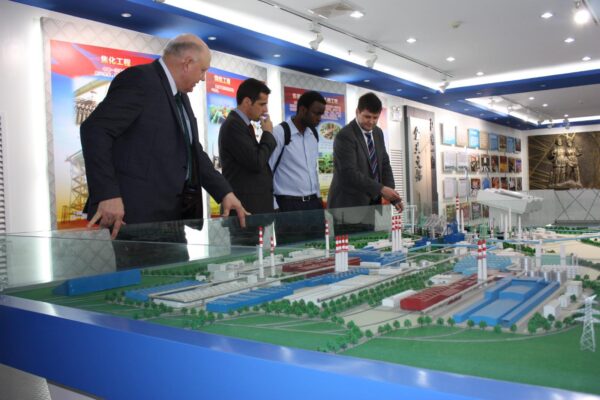
Compare what you see with what you were told. Use the same list at every plant.
Production
- Are the lines for your product running?
- Which raw materials are in use? Ask for mill certificates and batch records.
- Can you see your exact part, or one close to it, being made?
Quality control
- Is test equipment in use, such as hardness testers or chemical analysis tools?
- Ask for test records from recent orders.
- How are bad parts handled? How are batches traced?
Capacity
- Count the machines and shifts. Compare with the volume promised.
- What happens if one line goes down?
Packing and loading
- Heavy and bulk goods need strong packing. Ask to see a recent container load.
Problem: A local shortage and high prices in Australia.
Steps: Four rounds of testing on goods from a Chinese manufacturer.
Result: The buyer scaled up to a full container. It then added a second product.
Red Flags to Watch For
- The samples are better than the parts on the line.
- Staff will not show you certain areas.
- The license address does not match the plant address.
- No one can name the machines or materials used for your product.
- The tour is short and the sales pitch is long.
How to Verify What You Hear

A clean plant is not proof. Check the facts.
- License: match name, scope, and address.
- Certificates: confirm ISO 9001 and others with the body that issued them.
- Test records: ask to see real records, not a template.
- References: call two past overseas buyers.
- Third-party testing: for large orders, hire SGS, Bureau Veritas, or Intertek to test goods before they ship.
Plan Your Factory Visit With CAMAL
Problem: Cut cost with no drop in quality.
Steps: Two rounds of testing. Strict quality checks on certified goods.
Result: Final approval at two sites.
After the Visit: Score and Compare
Do not pick the manufacturer you liked most. Score every one on the same list.
| Factor | Weight | Example A (score out of 5) | Example B (score out of 5) |
|---|---|---|---|
| Product and spec fit | 25% | 5 | 4 |
| Quality system | 20% | 4 | 5 |
| Capacity | 15% | 4 | 3 |
| Relevant experience | 15% | 3 | 5 |
| Export record | 10% | 5 | 3 |
| Communication | 10% | 4 | 3 |
| Commercial terms | 5% | 3 | 5 |
| Weighted total | 100% | 4.15 | 4.05 |
These scores are made-up numbers to show the method. Change the weights to fit your project. Note how close the totals are. The scorecard shows the gap, so you can ask the right follow-up questions.
Then take these steps:
- Request samples and test them.
- Run third-party inspection.
- Place a small trial order first.
- Scale up only after the trial passes.
Common Mistakes
- Too many visits. Fewer, better-screened visits give better decisions.
- Choosing on price alone. The lowest quote can carry the highest risk.
- Taking the pitch at face value. Ask for evidence.
- No checklist. You cannot compare plants fairly without one.
- Not asking who makes the order. Confirm the plant you visit is the plant that makes your goods.
- Deciding on the plane home. Review your notes first.
Visit Alone or With CAMAL?

You can plan the trip yourself. That works when you already know the manufacturers and have local contacts. It gets harder with unknown manufacturers.
CAMAL is a paid advisory firm. It is not a broker, trader, or manufacturer. Offices are in Beijing, Hong Kong, Singapore, Nairobi, and Lusaka. CAMAL has worked with international buyers since 2011.
What buyers get at each step:
- Step 1, assessment: a shortlist of vetted manufacturers, pricing, landed cost, and manufacturer profiles.
- Step 2, factory visit and verification: CAMAL staff on site, checking lines, certificates, and test records with you.
- Step 3, managed delivery: shipping, customs, and delivery support. Only if you decide to proceed.
Learn more about how CAMAL runs sourcing from China, end to end.
Examples of CAMAL on-site work:
- Quality testing in China with a client, for a project in South Africa.
- A visit with a client to review a manufacturer’s past cement plant projects.
More CAMAL Case Studies

Each case below started with a buyer who was unsure. Each ended with tested goods and repeat orders.
- Kenya: The buyer feared scams and long lead times. CAMAL arranged secure shipping with tracking and confirmation. Result: 25 tons a month.
- Indonesia: The buyer had bad quality from a past manufacturer. All samples were approved. Papers were completed to UN standards. Result: 25 tons a quarter.
- Zambia: The buyer faced long lead times and high costs from Korea. CAMAL kept ready stock and shipped to site. Result: delivery 35 days faster, with lower landed cost.
- Norway: The buyer ran two rounds of sampling. The buyer replaced its European suppliers. Result: quarterly shipments.
Frequently Asked Questions
How long does a China factory visit take?
Plan 2 to 4 hours per manufacturer. A full trip is 5 to 7 days for one region.
Can I visit a manufacturer without an invitation?
Many accept visits. Always set the date first. If you show up unannounced, the right people are often away.
How many manufacturers can I see in a week?
Six to ten, if they are in one or two regions. Keep to two visits a day.
Do I need an interpreter?
Usually yes. Technical terms get lost without one. Pick someone who knows your product.
How do I know it is a manufacturer and not a trader?
Check the business scope on the license. Ask to see the production line. Match the license address to the plant. A manufacturer can show raw materials, machines, and test records.
What should I bring?
Bring your spec sheet, a sample of your current part, your checklist, business cards, and a notebook. Take photos of certificates, machines, and test records.
Conclusion

A China factory visit works when it has a clear goal. Screen first. Ask sharp questions. Check the line, the tests, and the papers. Score every manufacturer the same way. Then test a small order.
Planning a visit? CAMAL can check manufacturers before you fly, join you on site, and help after.
Related reading:
- Complete Guide to Sourcing Industrial Materials from China
- Tools for finding Chinese manufacturers
- Forget Google: Your Guide to Finding Industrial Manufacturers in China
- CAMAL: end-to-end sourcing from China
- Case study: a Brazilian CEO and a 30-day China supply chain
Ask CAMAL to Check a Manufacturer
CAMAL is a China-based sourcing advisory firm. It helps international buyers find, check, and buy from Chinese manufacturers. Contact: [email protected].
